Accident Forgiveness Coverage in California
The most popular advice about accident forgiveness coverage starts with a promise: your first at-fault accident won't raise your car insurance rate. That may be useful advice in states where insurers sell the feature. For a California driver, however, it leads to the wrong question. California drivers generally can't buy accident forgiveness as an available personal auto endorsement, so the practical issue is how to create rate stability without it.
Accident forgiveness is still worth understanding. It explains why one collision can affect renewal pricing, why a national advertisement may not apply to your policy, and why alternatives such as liability limits, deductibles, telematics, and careful carrier selection matter. The same broader planning issue affects California home insurance, renters insurance, and life insurance too: the right protection depends on the risks you face, the rules in your state, and the gaps a policy leaves behind.
What Accident Forgiveness Coverage Actually Does
A California driver may see an advertisement promising that a first at-fault accident won't increase the premium. After asking an agent to add the feature, that driver may discover the endorsement isn't available for a California personal auto policy. The confusion comes from treating a national insurance product as though every state uses the same rating rules.
Accident forgiveness coverage is generally an optional pricing feature. When an eligible policyholder has a qualifying at-fault collision, the insurer agrees not to apply the usual accident-related premium surcharge to that event. The feature doesn't pay for repairs, medical expenses, or damage to another vehicle. It also doesn't replace liability coverage, collision coverage, or the policy deductible.
The protection is about premium rating
The endorsement operates on the price of the policy, not the handling of the claim. Your liability insurance may still pay for covered damage to another person, and your collision coverage may still address damage to your vehicle after the deductible. The accident itself can still remain in the driving and claims history insurers review for underwriting.
State guidance describes the feature as an agreement not to factor a qualifying accident into premium calculation, rather than a deletion of the accident from the record. Massachusetts insurance guidance explains the pricing distinction, which is useful even though California's rules differ.
Without forgiveness, insurers commonly rate an at-fault accident for about three to five years, according to consumer and industry guidance on accident forgiveness. That means the potential value is the avoided surcharge over multiple renewals, not a payment received immediately after the crash.
Practical rule: Treat accident forgiveness as a one-event premium shield, not a promise that the accident disappears.
For California shoppers, the most useful starting point is a review of California auto insurance options. Ask whether a quote includes a genuine accident-related waiver or another feature with a narrower purpose. That distinction prevents you from paying for a benefit your policy doesn't provide.
How the Surcharge Mechanism Works
An insurer evaluates the driver, vehicle, location, coverage, and driving history together. An at-fault accident may move the policy into a higher surcharge tier, regardless of whether the insurer pays a claim. At renewal, the rating model combines that accident factor with other approved pricing variables.
Consumer analyses place the average premium increase after a first at-fault crash at roughly 40% to 56%, with one analysis citing an average increase of 44%. The Reviews.com analysis explains the range and gives a $1,800 premium example. At that cited increase, a driver paying $1,800 annually would face about $792 more per year.
The actual result can differ substantially. The insurer, prior driving record, accident details, territory, vehicle, and state filing all affect the calculation. A clean-driving discount may soften the final bill, while an expensive vehicle, a high-risk location, or other record issues may push it higher.
What forgiveness interrupts
Where an insurer offers the endorsement, accident forgiveness suppresses the accident surcharge step for one qualifying event. It does not hold the entire policy price steady. A renewal may still change because of vehicle costs, territory, broader insurer filings, coverage changes, or other rating factors.
| Driver Profile | Typical Surcharge | Duration on Record |
|---|---|---|
| Driver with a first at-fault accident | Roughly 40% to 56% on average | About three to five years |
| Driver with a clean prior record | The applicable carrier surcharge may still apply | Commonly about three to five years |
| Driver with other rating changes at renewal | No fixed accident-free result can be assumed | Depends on the insurer and state |
The word “forgiven” describes one pricing decision, not a clean slate. The insurer may decline to add the specific surcharge while still reviewing the event for future underwriting, eligibility, or a policy switch. A new carrier may also consider the accident without honoring the original insurer's forgiveness decision.
For questions beyond auto pricing, drivers can review the California insurance FAQ, then ask an agent to separate claim payment from renewal rating. That distinction helps clarify what the policy changes, and what remains part of the insurer's review.
Why California Drivers Can't Buy It
California is the important exception that national explainers often bury. Accident forgiveness is described as legally prohibited in California, so insurers can't offer California drivers this premium-protection endorsement under current rules. MoneyGeek's California explanation addresses the state-specific availability issue.
California's Proposition 103 framework and Department of Insurance filing requirements shape how insurers establish personal auto rates. That regulatory structure limits the way carriers can create and market a selective waiver for an at-fault accident. The result is straightforward for shoppers: asking a California insurer to “add accident forgiveness” usually doesn't produce the same product advertised in states such as Texas or New York.
What California shoppers may actually receive
A carrier may offer other pricing tools, but they aren't interchangeable with a true forgiveness endorsement. Depending on the insurer and policy, the conversation may involve:
- Accident-free discounts: A pricing benefit tied to maintaining a clean record, rather than a promise to waive a future accident surcharge.
- Renewal adjustments: A carrier-specific change in how an accident affects later pricing, subject to California rules and the insurer's filed rating plan.
- Deductible features: A vanishing deductible or similar benefit, which affects out-of-pocket claim costs rather than premium rating.
- Telematics pricing: A program that evaluates driving behavior and may change the base premium under its own terms.
Those options can be useful, but the policy documents should identify exactly what changes after a crash. Don't assume a discount, deductible benefit, or safe-driving program will erase an at-fault accident from underwriting.
California insurance questions can also overlap with licensing, compliance, and post-accident legal concerns. If a license issue affects your ability to drive or maintain coverage, review the 2026 reinstatement instructions from LA Law Group, APLC, and confirm the current requirements with the appropriate state agency.
The California strategy is therefore not finding a hidden forgiveness rider. It's building a policy that protects your finances, preserves continuous coverage, and gives you several ways to manage renewal pricing.
Eligibility Rules and Carrier Variations
In states where accident forgiveness exists, insurers don't offer it as a universal free rider. They usually reserve it for drivers with a relatively clean history because the endorsement is intended to protect against a limited event, not absorb repeated high-risk behavior.
A qualifying driver may need three to five clean years, depending on the carrier and program. Amica's claims forgiveness information illustrates how insurers can require clean driving periods and limit the benefit. Some programs also require no surchargeable claims, continuous policy tenure, or no other waived claim during a specified period.
Read the conditions, not just the headline
Rules can differ in several important ways:
- Driving history: A carrier may exclude recent at-fault accidents, major violations, DUI, reckless driving, or other serious events.
- Policy tenure: Some insurers require the driver to remain insured with that carrier before the benefit becomes available.
- Claim scope: Forgiveness often applies only to the first eligible at-fault accident on the policy.
- Driver scope: One program may protect each listed driver's first event, while another may allow only one forgiven accident for the entire policy.
- Additional conditions: Age requirements, approved defensive driving courses, claim severity limits, and household-driver rules may apply.
Major carriers also package the feature differently. GEICO and Travelers may price accident forgiveness as an optional endorsement in markets where it's offered. Allstate may include it within certain renewal or loyalty tiers, while Progressive has marketed Accident Forgiveness as a benefit available after a clean-record period. These examples don't establish California availability, and the current quote and policy form control.
| Carrier | Clean Record Required | Policy Tenure | First Accident Only | Age/Course Condition |
|---|---|---|---|---|
| GEICO | Carrier-specific clean-record rules | May apply by eligibility and policy terms | Commonly limited to an eligible first event | Confirm current state and policy requirements |
| Travelers | Carrier-specific clean-record rules | May apply before endorsement eligibility | Commonly limited to an eligible first event | Confirm current state and policy requirements |
| Allstate | May be tied to renewal or loyalty eligibility | Often connected to continued policy status | Program terms determine the limit | Confirm current state and policy requirements |
| Progressive | Clean-record period may unlock the benefit | Benefit depends on the program terms | Program terms determine the limit | Confirm current state and policy requirements |
The accident usually remains visible in claims or driving-history databases even when the original insurer suppresses its surcharge. Forgiveness also generally doesn't transfer to a new carrier, which makes switching a central part of the value calculation.
The Cost vs. Surcharge Tradeoff
The financial question is simple in principle. A driver pays a predictable amount for a feature today in exchange for protection against a potentially larger premium increase after a qualifying accident. The difficult part is that the driver doesn't know whether the accident will happen, whether the claim will qualify, or whether the driver will stay with the carrier long enough to use the benefit.
Independent guidance places the typical cost of accident forgiveness around 2% to 9% of the policy premium, with some estimates near 5%. Other guidance describes common pricing of roughly $50 to $200 per year, or about $4 to $10 per month, depending on the insurer and state. Experian's explanation discusses the common premium impact and the break-even question.
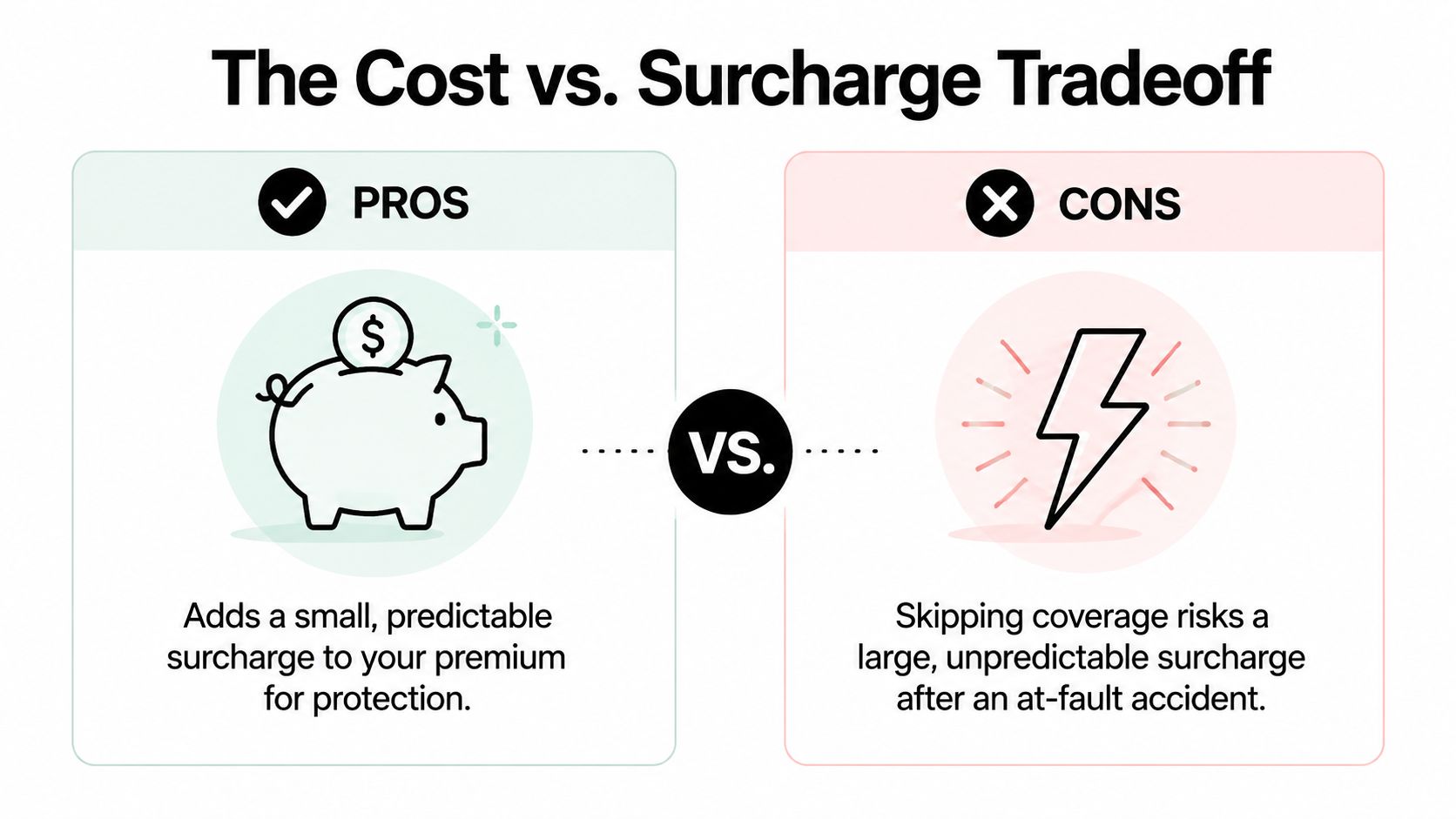
A driver who expects to remain insured with one carrier and values predictable budgeting may see the endorsement as a reasonable hedge. A low-mileage driver with little expected exposure may prefer to keep the money available for stronger liability protection or a more suitable deductible.
The break-even test: Compare the annual endorsement cost with the surcharge you could avoid, then ask whether the benefit follows you if you change insurers.
In California, the comparison changes because the endorsement isn't available. The same budget may produce more practical protection when directed toward liability limits, an emergency fund for deductibles, and collision choices, or a telematics program. Those tools don't replicate the legal feature, but they can reduce the financial shock associated with claims and renewals.
California-Friendly Ways to Stabilize Your Rates
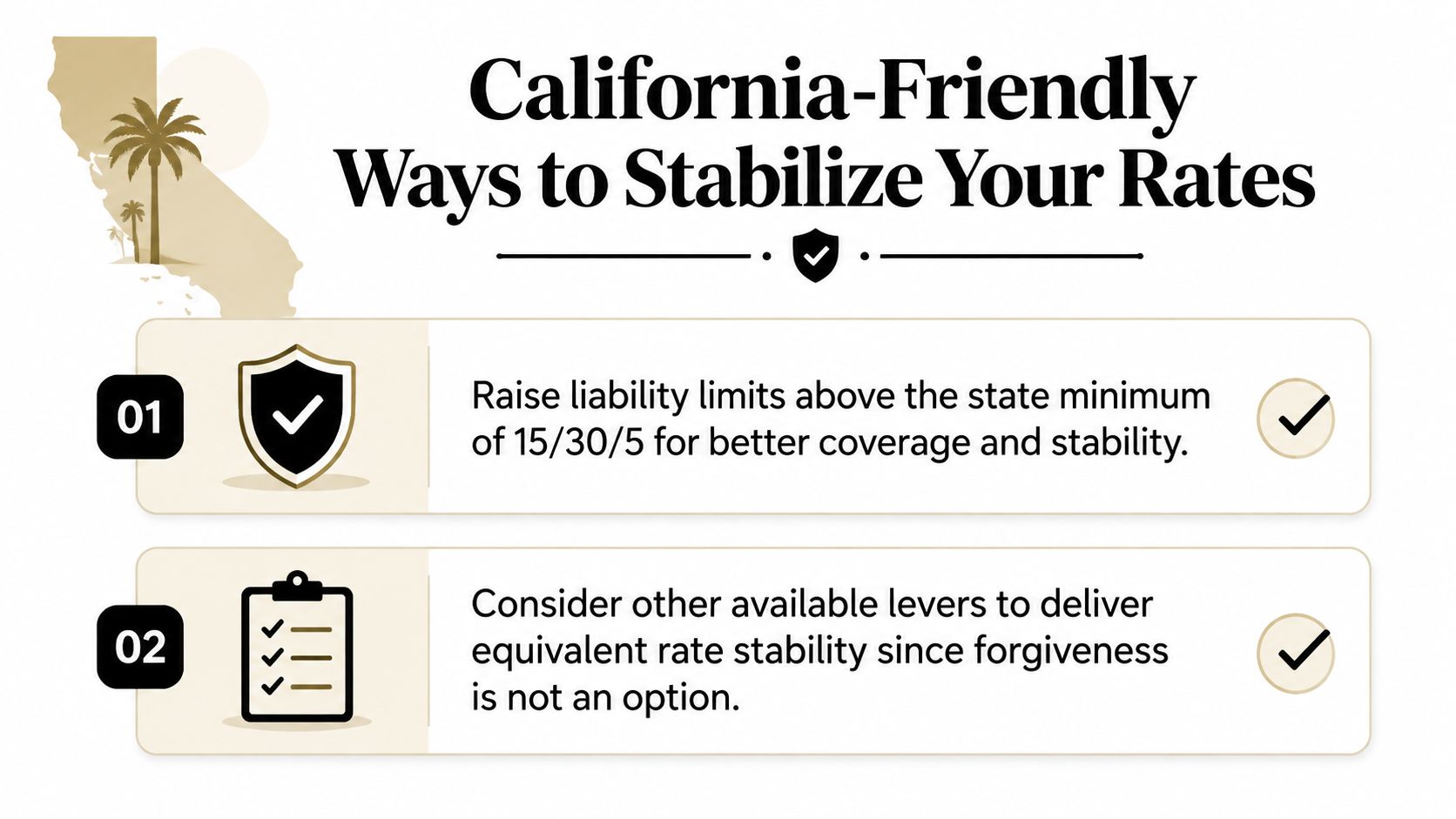
California drivers need a replacement plan, not a search for a product that the state doesn't make available. Start with the coverage that protects against the largest financial exposure, then use deductibles, driving data, and shopping discipline to manage the premium.
Put liability protection first
California's state minimum liability limits are 15/30/5, while a higher structure such as 100/300/100 can provide substantially more protection. The figures refer to bodily injury liability per person, bodily injury liability per accident, and property damage liability. Higher limits don't forgive an accident or guarantee a lower renewal price, but they can reduce the chance that one serious claim creates an uninsured financial problem.
Collision deductibles deserve a separate review. A driver who can comfortably absorb a $1,000 deductible may choose it instead of a $500 deductible to reduce the premium, but the right amount depends on available savings and the vehicle's value. Never choose a deductible you couldn't pay after a loss.
Use driving data and protect continuity
Usage-based programs such as Progressive Snapshot and GEICO DriveEasy can evaluate driving habits and may offer a pricing adjustment under the program's rules. The result isn't guaranteed, and drivers should understand what data the program uses before enrolling.
- Keep coverage continuous: Avoiding a lapse can preserve eligibility for carrier pricing and prevent a gap from complicating a future quote.
- Review the whole policy: Check liability limits, uninsured motorist protection, collision, coverage, and deductibles together.
- Shop deliberately: Compare the policy, not just the monthly price, when your record is clean or your circumstances change.
California drivers can use coverage guides for practical insurance comparisons, especially when auto insurance decisions overlap with home insurance, renters insurance, wildfire protection, or life insurance planning. The aim is balanced protection, not the lowest starting quote.
Two Real-World Scenarios Worth Comparing
Consider two drivers who hear the same national advertisement. Their choices look different because state availability, driving history, and the likelihood of staying with one carrier determine whether the feature has practical value.
Scenario A is a clean-record Los Angeles commuter. She has maintained a clean history and buys accident forgiveness in a state where her carrier offers it. A later at-fault fender-bender qualifies under the policy terms, so the carrier suppresses the applicable surcharge. In this example, avoiding the increase saves roughly $1,200 across three renewal cycles, making the rider economically worthwhile for her.
Scenario B is a Sacramento rideshare driver with a minor citation already on file. California rules prevent him from purchasing the endorsement. Even if he moved to Nevada, his existing record could make him ineligible under a carrier's clean-driving requirements. His more realistic approach is to review a usage-based program, choose a deductible he can afford, and confirm that his personal auto policy coordinates properly with rideshare coverage.
| Factor | Scenario A: Forgiveness Rider | Scenario B: California Alternatives |
|---|---|---|
| State availability | Available under the carrier's rules | California endorsement unavailable |
| Driving history | Clean record supports eligibility | Citation may complicate eligibility elsewhere |
| Main protection | Suppresses one qualifying surcharge | Manages exposure through coverage and pricing tools |
| Best next step | Confirm claim and switching conditions | Review telematics, deductible, limits, and rideshare needs |
The comparison shows why accident forgiveness isn't automatically the best answer. A driver must evaluate the record, the policy language, expected mileage, state rules, and plans to remain with the insurer. A California driver can still pursue rate stability, but the tools are broader and more practical than a single named endorsement.
FAQ and How Mai & Associates Can Help
Is accident forgiveness available from any California insurer?
No. California drivers generally can't buy accident forgiveness as a personal auto endorsement under current rules. Ask whether a quoted discount or deductible feature is a different benefit.
What happens after an at-fault accident without it?
The insurer may apply an accident surcharge at renewal. The amount depends on the carrier, record, accident, state rules, and other rating factors.
How long can the surcharge affect pricing?
Industry and consumer guidance commonly places the rating period at about three to five years. Reviews.com's accident forgiveness overview provides that general range.
Does forgiveness transfer to another insurer?
Usually not. The original carrier may suppress its own surcharge, while a new insurer can still review the accident when calculating a quote.
Does it transfer between cars?
It's generally attached to the policy and carrier, not permanently to the driver. Ask whether the benefit applies to a replacement vehicle or another listed vehicle.
What should I document after a crash?
Keep the date, location, driver details, photographs, police information, claim number, and medical records. If symptoms appear later, review resources about delayed soreness after a car crash and seek appropriate medical guidance.
Who can review my California options?
A licensed agency can compare your driving history, current declarations page, limits, deductibles, and available carrier programs. Request a California insurance quote review before changing coverage.
Mai & Associates can review your record and model rate impact across carriers such as GEICO, Progressive, and CSAA. The agency can recommend a California rate-stability plan, or explain whether an eligible out-of-state quote is worth considering when your residence and coverage situation support it.
Mai & Associates helps California drivers compare auto insurance, home insurance, renters insurance, and life insurance while identifying coverage gaps and practical ways to manage premiums. Visit Mai & Associates for a personalized review and a clear recommendation based on your driving record, budget, and California coverage needs.