Accelerated Benefit Rider Explained for Californians

A lot of California families buy life insurance thinking of one moment only. The day a benefit gets paid after someone dies. That's important, but it's not the whole story.
A serious diagnosis can change the financial picture fast. Mortgage payments still show up. Car insurance is still due. Utility bills don't stop because someone is in treatment or needs daily care. For many households, the central question becomes: can any part of our protection help while we're still living through the crisis?
Your Life Insurance Can Be for Living
Think about a family in Glendale, Costa Mesa, or anywhere else in California. One parent handles school pickup, the other keeps the household budget on track, and both assume their insurance plan is there for the “big emergencies.” Then a doctor delivers life-changing news.
The first shock is medical. The second is financial.
A family may already have auto insurance for the daily commute, home insurance to protect the house, and maybe renters insurance if they're building toward ownership. Those policies each solve a specific problem. Car insurance helps after a crash. Home insurance helps after covered property damage. Life insurance protects income and long-term family stability. But some life insurance policies can also do something many people don't realize. They may let the policy owner access part of the death benefit before death if the policy includes an accelerated benefit rider and the policy terms are met.
That can matter when a family needs money for care, time away from work, transportation, or changes to daily living.
Why families overlook this feature
Individuals often focus on premium, death benefit, and who the beneficiaries are. They don't spend much time asking what happens if the insured person survives for a period of time with a serious condition but needs help right away.
That's where the rider comes into the conversation.
A strong insurance plan doesn't work as isolated pieces. It works like a safety net, with life, home, renters, and car coverage each protecting a different part of family life.
For Californians reviewing their coverage, it helps to look at life insurance as one part of a broader household plan. If you're comparing policy options, this overview of life insurance in California is a good starting point for understanding how coverage fits into a complete protection strategy.
What Is an Accelerated Benefit Rider
An accelerated benefit rider lets the insured person receive part of a life insurance death benefit early if the policy's qualifying conditions are met. The money comes from the policy itself, so any amount paid out now usually reduces what beneficiaries receive later.
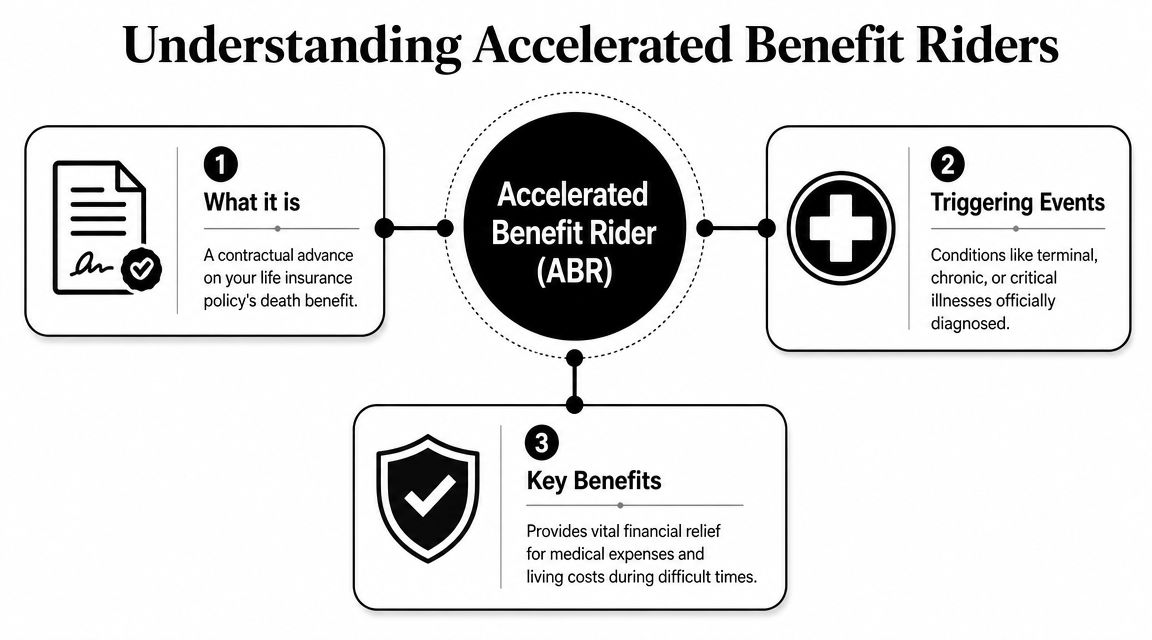
One insurer's plain-language description says an accelerated death benefit rider allows a policy owner to receive a portion of the death benefit before death after a qualifying condition, and that the advance reduces the later payout to beneficiaries. That same explanation says some policies include the rider at no added premium, while others apply a charge only if it is used, sometimes with a service fee or actuarial adjustment. You can read that description in this explanation of an accelerated death benefit rider.
A practical way to understand it is to picture the life insurance policy as a promise with two possible timing points. The usual timing is later, when beneficiaries receive the death benefit. The rider creates a limited early-access option if the contract says the insured person's medical situation qualifies.
That timing difference matters for families.
If a California parent becomes seriously ill and needs money for in-home help, travel to specialists, or time away from work, this rider may provide part of the policy value while the person is still alive. In exchange, the policy's remaining death benefit is usually smaller. For a household that is also budgeting for mortgage payments, car expenses, and property coverage, that tradeoff deserves the same careful review you would give to home or auto policy limits.
People also confuse this rider with other insurance or financing tools, so clear lines help. An accelerated benefit rider is a feature attached to a life insurance policy. It is governed by that policy's definitions, medical requirements, and payout formula. Health insurance still handles covered medical treatment under its own rules, and a personal loan follows a different repayment structure.
Why this matters in California insurance planning
California families often update auto and home coverage as life changes. Life insurance deserves that same attention, especially if the policy may need to support the family before a death claim ever happens.
The key is the contract language. Qualifying events, how much of the death benefit can be accessed, and how the insurer calculates the payment can differ from one policy to another. A plain-English insurance terms glossary can help if policy wording starts to feel more technical than it needs to be.
Practical rule: Before you rely on an accelerated benefit rider, confirm in writing what conditions qualify, how the payment is calculated, and how much death benefit would remain for your beneficiaries.
The Three Main Types of Accelerated Benefits
A good way to sort accelerated benefit riders is by the question the policy asks before it will release money. Is the insured facing the final stage of an illness? Has the person lost the ability to manage daily life without help? Or did a specifically named medical event happen?
Those questions lead to the three categories families usually see: terminal illness, chronic illness, and critical illness. For California households trying to protect income, housing stability, and long-term family routines, the distinction matters as much as the deductible on auto coverage or the limits on a homeowners policy. The label on the rider matters less than the rule written into the contract.
Terminal illness riders
Terminal illness riders usually apply when a doctor certifies that the insured has a condition meeting the policy's life-expectancy standard. The exact timeframe can differ by insurer, so the policy definition controls.
In practical terms, this rider is built for a period when a family may need money sooner rather than later. A spouse may need time off work. Mortgage payments still arrive. Car payments, insurance premiums, and household bills do not pause because a diagnosis happened. Early access to part of the death benefit can help cover those pressures while the insured is still alive.
The tradeoff is straightforward. Money taken early usually reduces what beneficiaries receive later.
Chronic illness riders
Chronic illness riders focus more on day-to-day functioning than on the name of a diagnosis. One insurer's policy form explains this clearly. North American's rider for accelerated death benefit for chronic illness says eligibility may depend on being permanently unable to perform at least two activities of daily living, or having severe cognitive impairment, with physician certification and an elimination period. The listed activities include bathing, continence, dressing, eating, toileting, and transferring.
That is where families often get tripped up. A person can be very sick and still not qualify under a chronic illness rider if the policy's functional test is not met. The insurer's inquiry goes beyond "Is this serious?" It is asking, "Does this condition prevent the insured from handling specific daily activities without substantial assistance?"
For a California family, this can connect directly to care at home. If cognitive decline is part of the picture, families exploring support options may also want to review Carevo's home care for Alzheimer's while comparing what the rider would and would not help fund.
Critical illness riders
Critical illness riders usually apply after a serious medical event or condition specifically named in the policy, such as certain forms of cancer, stroke, or heart attack if those conditions are listed. The key point is specificity. If the condition is not named or does not meet the policy definition, the rider may not pay.
This type can be easier to picture if you treat it like a checklist. The contract names the covered events, and the claim rises or falls on whether the diagnosis matches that list. Families often use these funds for recovery-related expenses, travel, missed work, or keeping regular bills current while life is temporarily upside down.
If you are comparing life, home, and auto protection as one family plan, articles on the California insurance blog for families and policy tips can help place this rider in the bigger picture instead of viewing it as a stand-alone feature.
Comparison of Accelerated Benefit Rider Types
| Rider Type | Common Trigger | Primary Use of Funds |
|---|---|---|
| Terminal illness | Physician-certified terminal condition that meets the policy's life-expectancy definition | Household stability, debt payments, end-of-life planning, family support |
| Chronic illness | Loss of functional ability, such as inability to perform required daily activities, or severe cognitive impairment under policy terms | In-home care, supervision, accessibility changes, ongoing living costs |
| Critical illness | A specified serious medical event or condition named in the policy | Recovery support, treatment-related costs, income disruption, family expenses |
Practical rule: match the family's situation to the rider's trigger language, not to the rider's name.
How These Riders Work in Real-Life Scenarios
Policy language can feel abstract until you attach it to family decisions. These examples are fictional, but they mirror situations families often face.

Keeping the house after a terminal diagnosis
A Southern California homeowner learns that their condition qualifies under the terminal illness language in the policy. The family's biggest fear isn't only treatment. It's whether the spouse and children will be able to stay in the home if income drops.
They elect to access part of the life insurance benefit early. That money helps reduce major housing pressure and buys time for the family to make careful decisions instead of rushed ones.
The rider didn't create extra wealth. It shifted part of the future benefit into the present, when the need was immediate.
Paying for help at home during cognitive decline
A retired parent begins showing severe cognitive decline. Family members can handle some care, but not all of it. They need support at home, guidance on routines, and relief for the primary caregiver.
If the policy's chronic illness rider applies, early access to the death benefit can help pay for home-based care and daily assistance. Families looking into in-home memory support may also find practical value in Carevo's home care for Alzheimer's, especially when they're trying to understand what day-to-day care can look like.
Covering the gap after a major health event
A working parent survives a serious medical event and can't return to normal work routines right away. Health insurance may handle treatment in its own lane, but the family still has ordinary bills. Gas, groceries, school costs, and car payments don't wait.
A critical illness version of an accelerated benefit rider may help bridge that household gap if the event is one of the policy's covered triggers. In practice, families often use the funds where pressure is highest, not where a budget spreadsheet says they “should.”
For readers who like examples tied to everyday insurance decisions, the articles on the California insurance blog can help connect life coverage choices with the broader realities of family budgeting, property protection, and car insurance planning.
Understanding the Costs and Financial Impact
A California family files a rider claim because a parent now needs daily care. The approval brings relief, then the next question lands fast. How much money comes out, and what does that do to the policy later?
That is the right question to ask.
An accelerated benefit rider gives your family access to part of the life insurance benefit while the insured is still living. The trade-off is simple. Money used now usually means less death benefit left for beneficiaries later. For many families, that is still a sensible choice because the financial pressure is happening in the present, not years from now.
A helpful way to picture it is a water tank with one supply. If some water is drawn out today, less remains for later use. Life insurance with an accelerated benefit rider works in a similar way. The rider can relieve pressure during a health crisis, but it changes what remains for final expenses, income replacement, or other family needs down the road.
The cost is not always a dollar-for-dollar advance
Many people assume that taking $100,000 early reduces the policy by exactly $100,000 later. Sometimes it is close to that. Sometimes it is not.
The actual payout can be lower than the portion of death benefit being accelerated. Policy language may allow an administrative charge, an actuarial discount, or another adjustment based on the insurer paying part of the benefit earlier than expected. In plain English, the carrier may calculate the present value of that future benefit instead of handing over the full face amount on a one-to-one basis.
That is why the election form matters so much. It should show what you receive now and what stays behind for your beneficiaries.
What Californians should measure before saying yes
This is not only a life insurance decision. It touches the full family protection plan. If a medical crisis affects driving, work hours, caregiving, or the home itself, the rider becomes one piece of a bigger insurance picture that may also include auto, home, umbrella, and final expense planning. Families who want a broader frame of reference can compare options through these California insurance planning guides.
Before signing, ask the insurer for a written illustration and review these points carefully:
- Remaining death benefit: How much will your beneficiaries still receive after the accelerated payment and any reduction?
- Actual cash paid now: What amount will the insurer send, and what adjustments were used to reach that number?
- Effect on permanent coverage: If the policy has cash value, will loans, growth, or other policy values change?
- Fees and charges: Is there an administrative fee or another cost tied to using the rider?
- Tax or benefits impact: Could the payment affect taxes or eligibility for public assistance programs?
One more question belongs on the list. If this rider is used now, will the remaining policy still cover burial costs and other end-of-life needs? Families caring for older parents often ask that right away, and this resource on securing parents' final expenses can help frame that conversation.
Ask for the numbers in writing before accepting a payout. A verbal summary is too easy to misunderstand when the decision changes what your family may receive later.
Used carefully, an accelerated benefit rider can protect a household during a medical crisis. The key is to treat it like an advance with consequences, not a bonus attached to the policy.
Activating Your Rider in California
When a qualifying event happens, families usually want the process to move quickly. The clearest way to reduce delays is to treat the claim like a documentation project from day one.
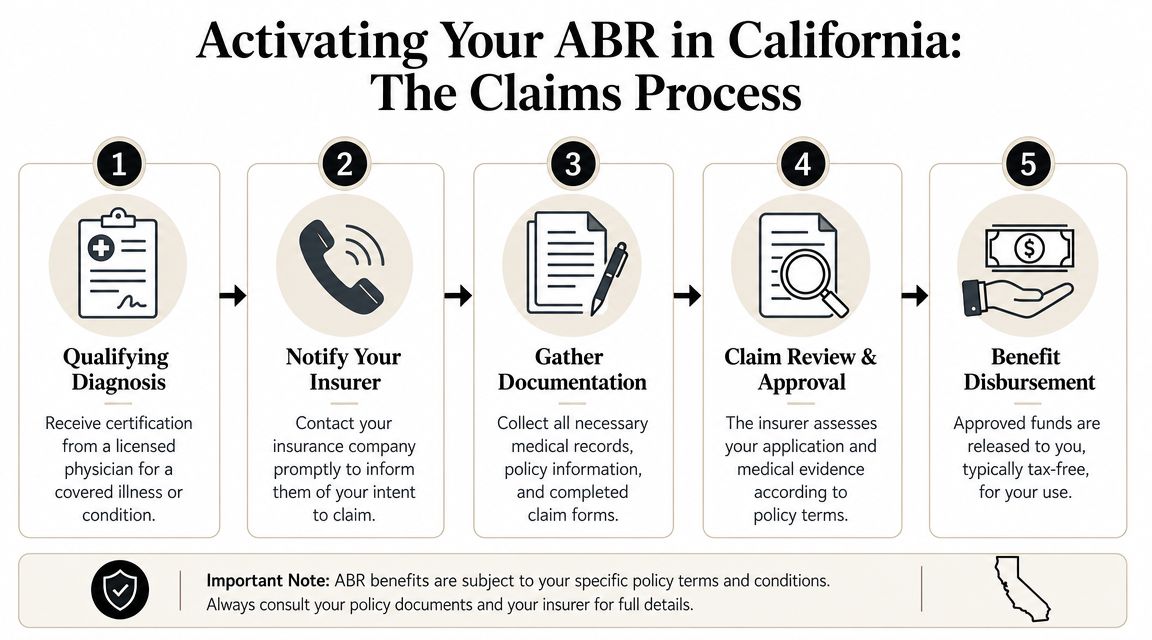
A practical step-by-step approach
Start with the policy itself. Don't rely on memory, a brochure, or what someone thinks the rider includes.
- Confirm the trigger language. Check whether the rider applies to terminal illness, chronic illness, critical illness, or another covered event.
- Get physician documentation. The insurer will typically require medical certification tied to the policy definition.
- Notify the insurer promptly. Ask for the exact forms needed for an accelerated benefit rider claim.
- Submit a complete package. Include claim forms, policy information, physician statements, and any requested records.
- Review the offer carefully. Make sure you understand the amount being offered and what remains for beneficiaries.
Where Californians should slow down
California consumers should pay close attention to written disclosures, claim forms, and any explanation of how the accelerated amount was calculated. If something is unclear, ask the insurer to explain it in writing.
Keep copies of everything. That includes emails, forms, medical certifications, and notes from phone calls. If a delay happens, your records become important.
Consumer protection mindset
A rider is part of the insurance contract. That means the claim should be evaluated according to the policy language, not according to guesswork or shifting explanations.
If you believe the insurer hasn't clearly explained the basis for a decision, ask for the specific policy provision they are using. If the first answer is vague, ask again. California families often do this with home insurance and car insurance claims. The same careful habits help here too.
Keep this file organized: policy copy, rider page, doctor certification, claim forms, insurer letters, and notes from every phone call.
Is a Rider Right for You How Mai & Associates Can Help
An accelerated benefit rider can be valuable, but it isn't automatically the right fit for every household. The better question is whether it fits your larger protection plan.
A good review starts with real-life questions, not sales language.
Questions worth asking yourself
- Would your family need money during a serious illness, not only after death?
- Do you have savings that could cover housing, car payments, and daily bills during a health crisis?
- Does your current life policy already include an accelerated benefit rider?
- If it does, do you know the exact trigger and payout rules?
- How would a reduced death benefit affect the people who depend on you?
If you own a home in a wildfire-prone area, drive daily in California traffic, or rent in a high-cost market, your risk picture is already layered. Life insurance should be reviewed the same way you review auto insurance, homeowners insurance, renters insurance, and broader family financial protection.
That's where a policy review helps. Mai & Associates works with Californians who want to compare options across auto insurance, car insurance, home insurance, renters insurance, and life insurance, then line those policies up so they work together instead of leaving gaps. With offices in Glendale, Westlake Village, Escondido, and Costa Mesa, the agency helps families compare carriers, understand coverage choices, and get guidance in plain language.
If you want a no-pressure review of your life insurance and the rest of your household protection plan, contact Mai & Associates. Their licensed California team can help you compare life, auto, home, and renters insurance options, spot coverage gaps, and find a policy mix that fits your budget and your family's needs.