Protect Your Family with 10 Year Term Life Insurance

You may be in that stage of life where everything overlaps at once. You've got a mortgage or rent, a couple of car payments, kids who depend on you, and a California cost of living that doesn't leave much room for financial mistakes. In that situation, life insurance usually isn't about building wealth. It's about keeping your family from having to scramble if your income disappears.
That's where 10 year term life insurance can make a lot of sense. It's a simple product built for a specific job. It can help cover a decade where your financial responsibilities are high, but not permanent. For many California families, that might line up with the years left on a mortgage, the time until kids are more independent, or the period when a business loan or auto loan is still hanging over the household budget.
If you already think about protection in layers, like car insurance for your vehicle, homeowners insurance for your house, renters insurance for your belongings, and life insurance for your income, this policy is easy to understand. It's one more piece of a practical protection plan.
Understanding 10 Year Term Life Insurance
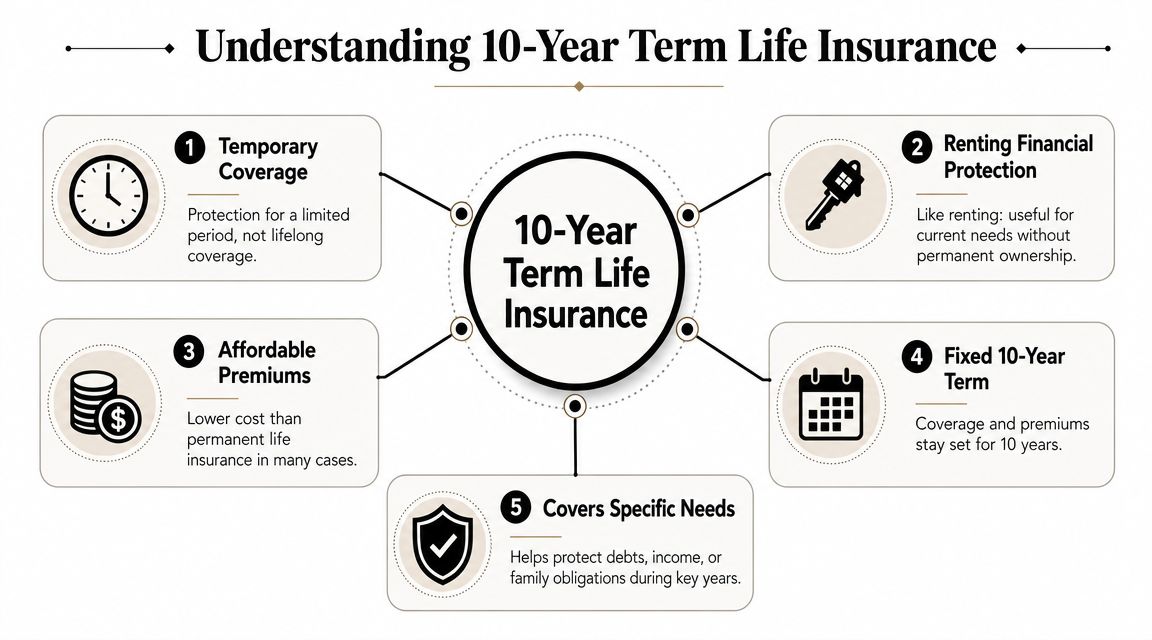
A parent in California dies unexpectedly. The mortgage is still due on the first. The car loan payment still hits the bank account. Grocery bills, childcare, and insurance premiums keep coming. A 10 year term life insurance policy is built for that kind of real-world gap. It provides coverage for a fixed 10-year period, and if the insured dies during that time, the beneficiaries receive the death benefit. If the insured outlives the term, the policy ends without a payout.
A short-term lease on financial security is a useful comparison.
You are paying for protection during a defined stretch of life, often the years when your household would feel the loss of your income the most. For many California families, that period lines up with a mortgage balance that is still high, auto loans that are not paid off yet, or children who still depend on your paycheck.
What the policy actually does
The main job of the policy is simple. It replaces financial breathing room at a time when your family may lose your income overnight.
That money can help a surviving spouse, partner, or children keep the household stable while they adjust. In a California household, that often means covering costs such as:
- Mortgage or rent payments
- Car loan payments and transportation costs
- Childcare, groceries, and other household bills
- Insurance premiums that still need to be paid to keep the rest of the protection plan in place
From a local agency perspective, this matters because families rarely face just one bill at a time. A life policy often needs to work alongside auto coverage, home or renters coverage, and an emergency fund. If you want to see how it fits into a broader California life insurance protection plan, that overview gives helpful context.
Why 10 years appeals to many families
A 10-year term works well when the problem has a clear end date.
Maybe you want coverage until the kids are older. Maybe you expect to pay down a large share of your mortgage over the next decade. Maybe one of the household cars will be paid off, or a business or personal loan will be gone by then. In each case, the policy is matched to a temporary risk instead of a lifetime one.
That point trips people up. They hear "life insurance" and assume every policy is meant to last forever or build cash value. Term life does neither. It is temporary coverage designed to protect income for a set period, and that is exactly why many families choose it first.
A good way to evaluate it is to ask one practical question. If you were gone tomorrow, would your family need help for the next 10 years more than they need coverage for the rest of their lives? If the answer is yes, a 10-year term policy may fit the job well.
How Your 10 Year Policy Works
A 10 year term policy works a lot like locking in a 10 year lease. You secure coverage for a set period, your cost is usually stable during that period, and the policy is there to protect your family if you die while it is active. For many California households, that makes it a practical tool for a specific stretch of life, such as the years when the mortgage is still heavy, the cars are not paid off, or the kids still depend on your income.
You apply, the insurer reviews your risk, the company offers coverage if you qualify, and you pay the premium to keep the policy active. If you die during the 10 year term, the death benefit is paid to your beneficiaries. If you are still living when the term ends, the policy does not pay out just because time passed.

Underwriting and approval
The first moving part is underwriting. That is the insurer's review of your risk.
The company will usually look at your age, health history, prescriptions, tobacco use, driving record, and sometimes your job or hobbies. Some applicants complete a medical exam. Others qualify through a simpler process that uses health questions and data sources instead. The goal is straightforward. The insurer is deciding whether to offer coverage and what premium to charge.
If terms like beneficiary, rider, conversion, or underwriting feel unclear, this plain-language insurance glossary can help make the application process easier to follow.
What happens during the term
Once the policy is in force, the main job is simple. Keep the premium paid and keep your beneficiaries up to date.
Many 10 year term policies use level premiums, which means the payment generally stays the same throughout the term. That predictability matters in California, where families are often balancing a mortgage or rent, auto loans, insurance on the home and cars, and everyday living costs. A fixed life insurance payment is easier to build into a household budget than a cost that changes every year.
Beneficiaries matter more than many buyers expect. If you get married, divorced, have a child, refinance a home, or take on a shared debt, it is smart to review who would receive the money and whether the coverage amount still matches the financial job you want the policy to do.
What happens at the end
A 10 year term policy has an expiration date. That is one of its biggest strengths and one of the easiest parts to misunderstand.
At the end of the term, a few outcomes are common:
- You let the policy expire if the need for coverage has passed.
- You renew the policy if your contract allows it, though the cost is usually much higher at that point because you are older.
- You convert the policy if it includes a conversion option, which may let you switch to permanent coverage without going through a new full health review.
A local agency often sees this issue come up when families buy term insurance for one clear goal, then life changes before the 10 years are up. A couple may start with coverage meant to protect a mortgage payment and later realize they also want a longer plan for estate needs, a special-needs child, or a business obligation. That is why it helps to ask about renewal and conversion rules before you buy, not after year nine.
Riders as optional upgrades
Riders are add-ons that can change how the base policy works. Some are useful. Some just add cost.
A simple way to view them is the same way you would view options on a car. If the feature solves a real problem, it may be worth paying for. If it does not match your situation, skip it.
Common examples include:
- Waiver of premium, which may keep the policy in force if you become disabled and cannot work
- Accelerated death benefit, which may allow early access to part of the death benefit in certain serious health situations
- Child or spouse riders, depending on the carrier and policy design
The best rider mix depends on the job the policy is supposed to do. If your main goal is to protect your family through a defined California expense window, such as a mortgage, car debt, or the years your children still rely on your income, keep the structure focused and easy to manage.
Is a 10 Year Term Policy Right For You
A 10 year term policy makes the most sense when your need has a clear finish line. The easiest way to judge that is to look at real-life situations, not product labels.
A homeowner in Escondido
A couple in Escondido buys a home later than they originally planned. They've made progress in their careers, but they still have a stretch of years where one income carries most of the mortgage. They also have two cars, both with ongoing expenses tied to commuting, maintenance, and insurance.
For them, a 10 year term policy can work like a financial bridge. It helps protect the period when the mortgage is still a major monthly obligation and the household would feel a sharp hit from losing one paycheck. It also supports the larger California protection plan they already have in place through home insurance and car insurance.
A business owner in Westlake Village
A startup founder in Westlake Village has a business loan tied closely to personal finances. The company may do well over time, but right now the owner's family would be exposed if something happened unexpectedly.
A 10 year term policy fits when the goal is narrow and practical. Keep the business debt from spilling into family finances. Cover a defined decade when the company is still maturing. Revisit the plan later if the business becomes stable enough that a different insurance strategy makes more sense.
Parents in Glendale
Newer parents in Glendale often have the same concern, even when their details differ. One parent may earn more, but both contribute real economic value to the household. If one dies, the survivor may need help paying for childcare, rent or mortgage costs, transportation, and daily bills.
A family doesn't need to be wealthy to need life insurance. They just need people who depend on their income or unpaid work.
For these parents, 10 year term life insurance can cover a critical stage when children are still young and household costs are front-loaded. If they expect their savings, career growth, or debt payoff to change their picture over the next decade, a shorter term may line up well.
Someone close to retirement in Costa Mesa
Another common fit is a person who's nearing retirement and doesn't want to carry lifelong coverage they may not need. They may have fewer years left on key debts, and their goal is to protect a spouse until retirement assets become the main support system.
That's a very different use case from a young family. But the logic is the same. Temporary need, temporary coverage.
A 10 year policy may be worth a closer look if your main concern sounds like one of these:
- You're covering a mortgage or rent-heavy decade
- You want to protect against auto loans or other household debts
- Your children will be far more independent in about 10 years
- You expect retirement, debt payoff, or asset growth to reduce your need later
If your obligations will likely last much longer than that, a longer term may fit better. The product isn't “good” or “bad” on its own. It's useful when the timing matches your life.
What to Expect for 10 Year Term Life Insurance Costs
A common California scenario looks like this. You have a mortgage or high rent, one or two car payments, and kids who still depend on your income every month. In that situation, the cost question is not only “What will I pay for coverage?” It is also “What would my family need covered for the next 10 years if my paycheck disappeared?”
That framing helps because 10 year term life insurance is usually priced around a short protection window. You are not paying for lifelong coverage. You are paying for a defined period when your family may still be carrying major obligations like housing, auto loans, childcare, and day-to-day bills.
What drives the premium
Life insurance companies price 10 year term policies based on a few basic risk factors. Your age matters. Your health history matters. Tobacco use matters. The death benefit you choose matters too.
A simple way to read it is this: lower risk usually means a lower premium, and a larger coverage amount usually means a higher premium. Someone applying at 30 will often see a lower rate than someone applying at 40. A nonsmoker will often see a lower rate than a smoker. Two people buying the same policy length can still get different quotes because carriers weigh health details and underwriting rules differently.
That is why it helps to shop quotes before you assume a policy is out of reach.
Sample 2026 annual premiums
Published sample rates give a rough benchmark for how pricing can change by age, gender, and coverage amount. Here is a simplified view of examples noted earlier in the article.
| Age | Gender | $250,000 Coverage | $500,000 Coverage | $1,000,000 Coverage |
|---|---|---|---|---|
| 30 | Male | $129 | $174 | $264 |
| 30 | Female | $117 | $149 | $217 |
| 40 | Male | $162 | Not provided | Not provided |
| 40 | Female | $149 | Not provided | Not provided |
The point of a table like this is not to predict your exact premium. It is to show the pattern. Buying younger often lowers cost, and raising the death benefit does not always increase the premium as sharply as people expect.
That matters for California families. A policy that looks “small but affordable” may not go very far if the goal is to protect a mortgage payment, replace income for several years, and keep up with car loans and household bills.
A practical way to budget for coverage
A better starting question is, “What bills would still land in my family's lap next month?”
For many households in California, the answer includes:
- Housing costs such as mortgage payments, rent, property taxes, or HOA dues
- Transportation costs such as car loans, fuel, maintenance, and auto insurance
- Family living costs such as groceries, utilities, childcare, and school expenses
- Other insurance needs such as homeowners or renters coverage that should stay in force during a financial shock
Understanding local considerations is beneficial. A family in Costa Mesa, Irvine, or elsewhere in Orange County may face a very different housing budget than a family in a lower-cost part of the state. The premium for life insurance is only one line in the budget. The bigger question is whether the death benefit would give your family enough room to keep the house, keep the cars, and avoid scrambling to cut every expense at once.
If you want a helpful starting point for reviewing those overlapping risks, our California insurance guides for home, auto, and family protection can help you map out the bigger picture.
Don't base your coverage amount only on what feels easy to spend each month. Base it on what your family would need protected during the next decade.
The best fit is usually a balance. You want a premium that works in your current budget and a coverage amount that would still do its job if your income were gone tomorrow.
How 10 Year Term Compares to Other Policies
A 10 year term policy usually makes the most sense when your coverage need has a clear finish line. In California, that might mean protecting your family until the mortgage balance drops, an auto loan gets paid off, or your children move through a costly stage of life.
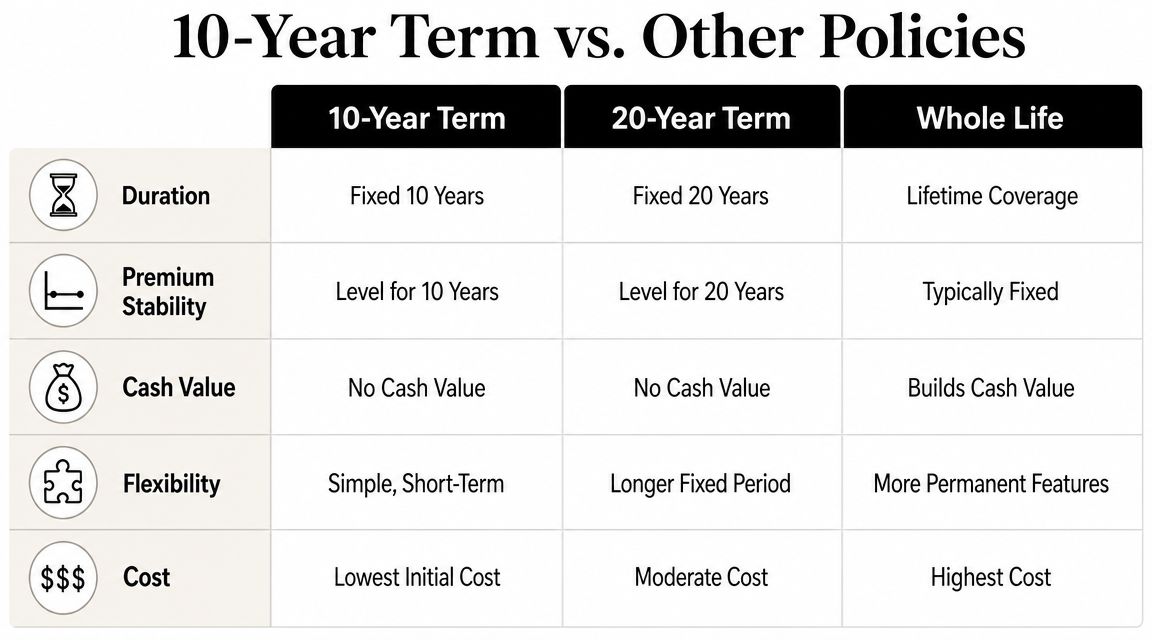
The comparison is not just price. It is how closely the policy length matches the bills and responsibilities your family would still face if you were gone.
Compared with 20-year term
A 20-year term gives you a longer guaranteed period, so the premium is usually higher than a 10-year term. In return, you may avoid having to apply again later at an older age, when rates are often less favorable and health changes can affect your options.
That difference matters for California households with debts that will not disappear quickly. If you bought a home in Orange County a few years ago, for example, your mortgage may still be a major part of your family's budget well beyond the next decade. In that case, a 20-year term can line up better with the risk you are trying to cover.
A 10-year term can still be the better fit if the need is shorter. Maybe you are 8 years from paying off a car loan and 10 years from seeing your youngest child finish high school. That is a narrower job, and a shorter policy can match it well.
Compared with 30-year term
A 30-year term is built for long obligations. New parents, younger couples buying their first home, and families starting a 30-year mortgage often look here because the financial exposure lasts much longer.
The tradeoff is simple. You pay more for a much longer guarantee.
If your main goal is to protect one specific decade, such as the years when your mortgage payment, child-related costs, and household debts are all at their highest, a 30-year term may give you more duration than you need. If your family would still depend on your income far beyond that point, the longer term may be worth the added cost.
If you want help comparing policy lengths alongside home, auto, and household risk, our California insurance planning guides for families give a useful broader view.
Compared with whole life
Whole life is a different kind of product. It is permanent coverage, and some policies build cash value over time. Term life is usually more direct. You pay for a set death benefit during a set period.
A simple way to compare them is to look at the job each policy is meant to do. A 10-year term works like a contract for a specific project. Whole life is closer to a long-term position designed to stay in place for life, as long as premiums are paid.
- 10 year term fits temporary income protection
- Whole life fits lifelong coverage and policy features that go beyond temporary protection
For many California families, the starting question is practical. Are you trying to make sure your spouse can keep making the mortgage payment, cover auto loans, and keep the household stable for the next 10 years? If so, term often fits that job cleanly. If your goal includes lifelong coverage, estate planning, or permanent policy value, whole life may deserve a closer look.
Choose the policy that matches the length and type of risk your family actually has. A short coverage need and a lifelong coverage need are different problems, and they usually call for different solutions.
How to Secure Your California Life Insurance Policy
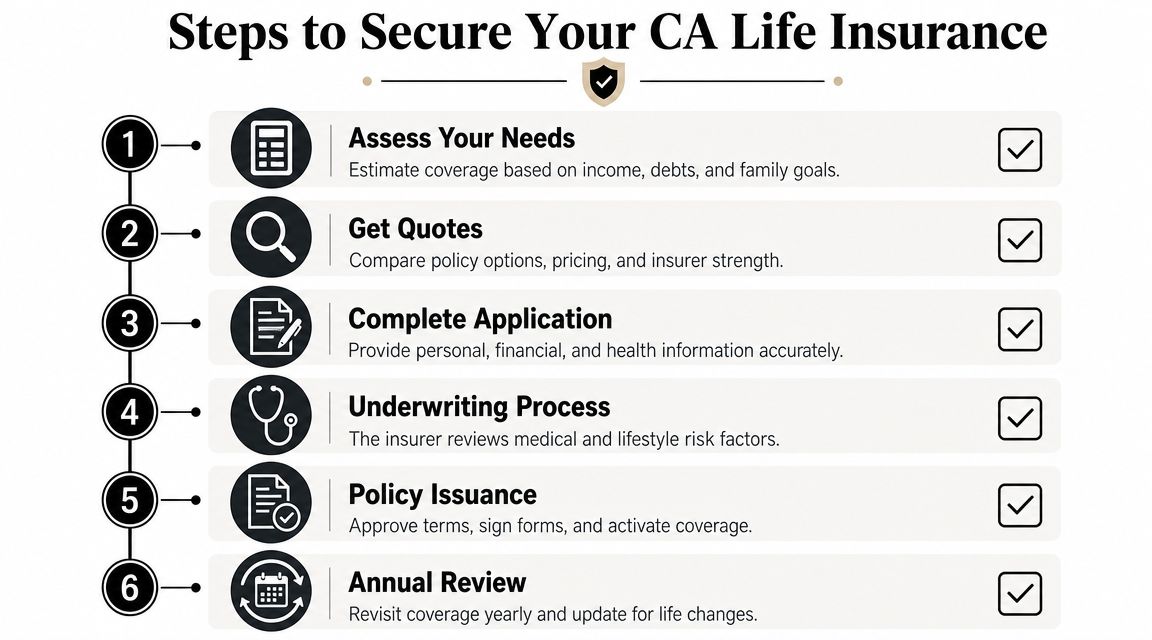
Buying life insurance doesn't need to feel complicated. The process gets easier when you treat it like the rest of your insurance planning in California. You identify the risk, estimate the exposure, compare options, and choose a policy that fits your budget.
Start with the obligations your family would inherit
Write down the bills that would still exist if you died. Think in household terms, not just in insurance terms.
That often includes:
- Housing payments such as mortgage or rent
- Vehicle-related costs including auto loans and car insurance
- Family living expenses such as groceries, childcare, and utilities
- Property protection costs such as home insurance or renters insurance
Once you see those obligations in one place, the reason for life insurance becomes much clearer.
Compare more than one quote
Term life can look similar from carrier to carrier, but pricing, underwriting style, and conversion features can vary. That's why comparison matters.
A local independent agency can help if you want multiple options without going company by company on your own. For example, Mai & Associates quote options allow Californians to request insurance quotes across products, including life insurance, as part of a broader review.
Review your full protection plan
Life insurance works best when it isn't isolated from the rest of your financial protection. A California household often needs these pieces to work together:
- Life insurance to protect income
- Auto insurance to protect drivers and vehicles
- Home insurance or renters insurance to protect the place you live and what you own
If one area is underinsured, the whole plan gets weaker. A family can have solid car insurance and home insurance, then still face a major gap if there's no protection for income loss.
Ask the right questions before you sign
Before you finalize a policy, make sure you understand:
- How long the premium stays level
- What happens when the 10 years end
- Whether the policy offers conversion options
- Which riders are available and whether they solve a real need
That short conversation can prevent surprises later. It can also help you avoid buying a policy that looks inexpensive but doesn't fit the actual reason you wanted coverage in the first place.
A 10 year term life insurance policy is often the right answer for a focused California need. It can cover a mortgage window, protect a family while debts are still high, or support the years before retirement changes the picture. The key is matching the policy term to the period your family is financially exposed.
If you want help comparing life, auto, home, renters, or car insurance options in California, contact Mai & Associates for a no-obligation quote and a practical review of your overall protection plan.